
Outdoor advertising in Delhi NCR: how to choose sites that work
Hoardings, unipoles, standees and the rest — how to pick a site for the people who pass it, and write something they can read at sixty kilometres an hour.
ABC Mediamix editorial team4 min read
Outdoor advertising — also called out-of-home, or OOH — is every ad people see while they're out: hoardings, unipoles, bus shelters, metro panels, screens in malls, standees at the entrance. In Delhi NCR, where so much of life happens on the road between Delhi, Noida, Ghaziabad and Gurugram, it's one of the most powerful local media there is. It's also the easiest to waste money on, because a site can look impressive on a proposal and be invisible from the road.
The formats
| Format | What it is | Best at |
|---|---|---|
| Hoarding / billboard | A large panel by the road, on a frame or a building | Fame and repetition on a route |
| Unipole | A panel on a single tall pole, often by highways and expressways | Visibility from a distance, at speed |
| Gantry | A panel across the road | Unmissable placement on a specific road |
| Backlit panel | A lit box, often at eye level | Night visibility, shorter reading distance |
| Transit and metro | Bus shelters, buses, metro stations and trains | Commuters, with longer dwell time |
| Mall and venue media | Standees, roll-ups, screens | Reaching people already in buying mode |
| Digital OOH (DOOH) | Screens that rotate several advertisers' ads | Changing messages by time of day |
How to choose a site
A site is only as good as the people who pass it and the attention they can give it. When we assess a site, these are the questions we ask:
- Who passes it, and where are they going? A site on the route from a residential sector to an office hub sees the same people twice a day. A site near a mall on a weekend sees shoppers.
- Which direction does it face? A panel that faces morning traffic is seen by a different audience from the one that faces the evening.
- How long can it be read? On an expressway, a second or two. At a signal or on a congested road, much longer. The copy has to match.
- Can it actually be seen? Distance from the road, angle, height, trees, other hoardings around it, and whether it's lit after dark. Visit before booking, or ask for photographs from the driver's point of view.
- Is it relevant to where the sale happens? A site close to the project, store or campus — or at the turning to it — can convert interest into a visit in a way a citywide site can't.
Where in NCR
There's no single best corridor — only the best one for a particular buyer. Our own outdoor work has concentrated on the routes buyers take to the projects: the Noida and Yamuna Expressways, the DND Flyway, NH-24 towards Ghaziabad, the Dwarka Expressway, Sohna Road and the KMP Expressway. A Yamuna Expressway project wants the Yamuna Expressway; a school in Noida Extension wants the roads its parents drive. We wrote about why the location so often becomes the headline itself in The address is the headline.
Writing for a glance
The most common outdoor mistake is a newspaper ad put on a pole. A widely used rule of thumb is to keep a roadside hoarding to about seven words; whatever the exact number, the discipline is the same — one thought, one image, one action.
- Make the brand name big enough to read from the farthest point the site is visible.
- Use strong contrast. Pale type on a busy photograph disappears at distance.
- Give one way to respond — a short number or a direction to turn, not a website and three numbers.
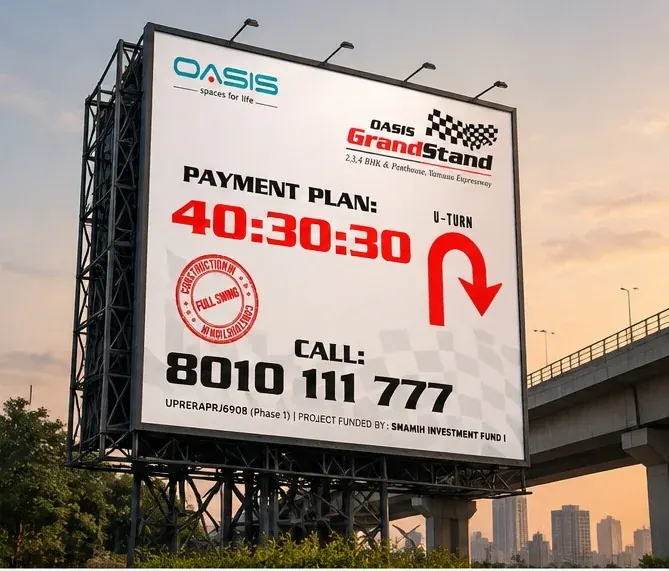
- Let the site do some of the talking. The Oasis Grand Stand board near the project carries little more than a payment plan, a phone number and a U-turn arrow.
A hoarding has one job. Give it two and it does neither.
Permissions, printing and duration
Outdoor advertising sites are licensed by local authorities, and rules differ between Delhi, Noida, Ghaziabad and Gurugram. An established media owner or agency handles this, but it's worth confirming that a site is legally permitted before you pay for it — an unauthorised site can be taken down mid-campaign. Sites are usually booked by the month. Printing (flex or vinyl) and mounting are often quoted separately from the site rent, so ask for both.
Measuring outdoor
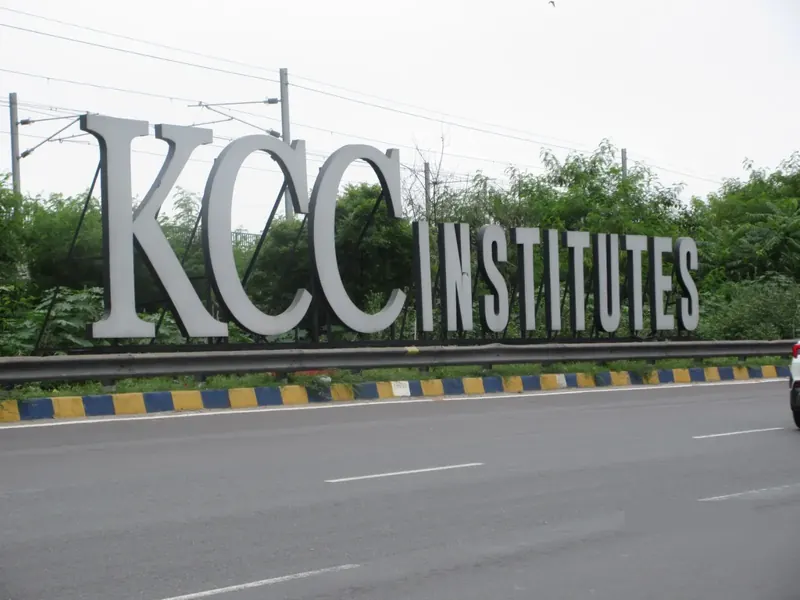
- Ask for photographs of the work once it's up — with the date — as proof of display. It’s why our archive includes site photographs like the KCC Institutes letters beside the DND Flyway.
- Use a phone number, WhatsApp number or QR code that appears only on outdoor.
- Ask every enquiry where they saw you, and log it consistently.
- Compare enquiries and site visits from the area around the sites before and during the campaign.
What's the difference between a hoarding and a billboard?
In Indian usage they mean much the same thing: a large outdoor advertising panel. “Hoarding” is the more common everyday word in India; “billboard” is used interchangeably.
Is digital outdoor better than a static hoarding?
Not better — different. Digital screens let you change messages by time of day and share a prime location with other advertisers, so you get a fraction of the time. A static hoarding is yours alone, all day, for the month.
How much does a hoarding cost in Delhi NCR?
Site rents vary enormously by size, location, visibility and the time of year, and printing and mounting are usually extra. The useful comparison isn't the rent but the cost per enquiry or visit once the campaign has run.
We plan, write and place outdoor campaigns across NCR — see outdoor advertising with ABC Mediamix, or start a conversation.